G R O U P S & C O U R S E S
Coming home to the body
A six-session trauma-informed course in somatic awareness, movement, emotional integration and connection.

You may understand a great deal about yourself and still find it difficult to feel what is happening in your body, recognise what you need, or bring your emotional experience into relationship with others. This could lead to becoming overwhelmed, tense, numb, shut down or stuck without fully understanding why. You may find that words only take you so far, or that what you know intellectually does not always translate into a felt sense of safety, choice or connection.
This course offers a gradual and supported way to explore these connections through body awareness, movement, reflection and shared learning. Together we will look at how you relate to your body, emotions, nervous system and outward expression.
The aim is not simply to introduce somatic or movement practices, but to help you develop a deeper relationship with your emotional self and explore what becomes possible when this experience is held in connection with others.
No previous experience of movement, yoga, somatic practice, counselling or psychotherapy is required. All participation is invitational. You will not be expected to move in a particular way, speak in every session or disclose personal experiences you would prefer to keep private.
Movement may be small, large or internal. Stillness, watching and resting are equally welcome.
Please see below for the details of each session and outline for the six weeks.
D A T E S
27 September · 11 & 25 October · 8 & 22 November · 6 December
Six Sundays, fortnightly
T I M E
2.00 – 4.00 pm
W H E R E
Om is Where the Heart is
Taylor Hill Mills, Fairlea Road
Huddersfield, HD46JA
G R O U P S I Z E
Minimum three, capped at ten
To keep the group contained and supportive
C O S T
£240 for the full six sessions
Access rate £160–180, limited availability
B E F O R E B O O K I N G
Feel free to arrange a 15-minute phone call for a chat to ask questions and consider together whether the group is likely to feel supportive for you.
You’re welcome to participate in your own way
You are equally welcome whether you have a great deal to say, would prefer to learn and observe quietly, or need to stay towards the edge of the group while you become familiar with the space. Needing privacy or protection will not be treated as resistance or failure. Safety may begin with being allowed to remain less visible while still being included. Showing up without being required to expose yourself is a form of participation in itself. It is my intention that those who need the protection of hiding in the back will still feel recognised as part of the group.
Many people find that this kind of gradual approach allows them to move closer to feelings or parts of themselves that have felt protected, distant or difficult to access, without becoming overwhelmed.
This is an invitation to dip a toe into the waters of feeling something new, particularly where this may feel inaccessible to explore alone.
The six sessions
Safety, choice and boundaries
How a sense of safety develops within ourselves and in relationship with others. What co-regulation means, and how choice, boundaries and pacing influence our capacity to participate and connect.
Being witnessed without judgement
Nonjudgemental witnessing alongside practices for grounding, centring and orienting to the present. What it is like to notice ourselves while also being seen, without needing to perform or become someone different.
Understanding your nervous-system patterns
Polyvagal theory in relation to hatha yoga, breathing practices and everyday emotional experience. Identifying your most familiar or “home” state, and how activation, settling, connection and protection show up in your body.
Anger, fear and agency
Activation, and the relationship of anger and fear to protection, action and choice. Rather than treating these emotions only as problems to regulate away, we consider the information they carry about boundaries, needs and agency.
Is this rest or collapse?
The differences between restoration, slowing down, shutdown and feeling stuck. How stillness may be connected with rest and safety, but may also become entangled with shame, withdrawal, helplessness or collapse.
Play, creativity and connection
Bringing together different nervous-system states to explore play, creativity and togetherness — and how a sufficient sense of safety can create greater freedom to experiment, take manageable relational risks and find new forms of expression.
Who this course is for
This course may be helpful for people who:
are seeking greater connection with their bodily or emotional experience
are interested in understanding their nervous-system patterns
understand themselves intellectually but find it difficult to feel or express what is happening inside
become overwhelmed, disconnected, numb, tense, shut down or stuck
find it difficult to identify or communicate what they feel and need in relationships
would like to feel part of a group but find it difficult to bring themselves forward
are curious about counselling or psychotherapy but are unsure whether they are ready
have experienced trauma, neglect, abuse or other life-altering events that have affected their sense of safety, embodiment, emotional expression or connection
would like a gentle, educational and experiential group rather than intensive trauma processing
The course may also be valuable for therapists, counsellors and other helping professionals, as well as people working in yoga, Pilates, somatics, bodywork or embodied movement practices who would like to explore the relationship between their professional work and their emotional experience.
What you do not need
previous experience of yoga, dance, movement or somatic practice
to be flexible, physically confident or comfortable performing in front of others
to speak or share in every session
to disclose trauma or personal history
to know exactly how you feel before you arrive
to push yourself beyond what feels manageable
to participate in every exercise in the same way as everyone else
Where needed, practices can be adapted to support different bodies, energy levels and access needs. Please contact me before booking if you would like to discuss a particular physical, sensory or accessibility requirement.
The shape of each session
30 min
Arrival and settling in
Breathwork and gentle stretching, followed by an optional group movement circle. This opening helps us arrive gradually, notice how we are, and begin developing a shared rhythm.
40 min
Guided teaching and experiential practice
Structured teaching on the connections between emotion, interoception, expression and relationship, followed by a practice linking inner experience with outward expression. You will receive a handout each session.
10 min
Journaling and self-care break
Time for individual writing and rest. Your writing is for your own reflection. There is no expectation to share from it.
20 min
Reflection and integration
A chance to ask questions and reflect on what you noticed. You may share as much or as little as feels right. What emerges here informs the shape of our closing practice.
20 min
Closing practice
A guided practice combining mindfulness, breathwork and gentle yoga postures — or, depending on the energy of the group, a return to the movement circle or a somatic exercise alone or in pairs.
What this course is — and is not
This is a structured, trauma-informed course combining psychoeducation, body awareness, movement, yoga-informed practices, journaling and shared reflection. It offers a therapeutically held environment in which you can develop greater awareness of your body, emotions and relational patterns. Participation is paced carefully, confidentiality and boundaries are explicit, and no one is encouraged to move, speak or disclose more than feels manageable.
It is not a substitute for individual psychotherapy, group psychotherapy, medical treatment or crisis support. Although the course may be meaningful for people affected by trauma, it does not involve detailed trauma disclosure or intensive processing of traumatic memories.
Arranging an introductory call
If you’d like to speak before booking, please get in touch to talk about what you are hoping for, ask anything about the movement, structure or accessibility, and make sure the course is likely to offer the right level of support for you.
If you’re ready to book, you can do so through the Om is Where the Heart is workshops page and scroll through to Coming Home to the Body.
michelle@michellegoldsmiththerapy.com
+44 7585 635 994
About Michelle
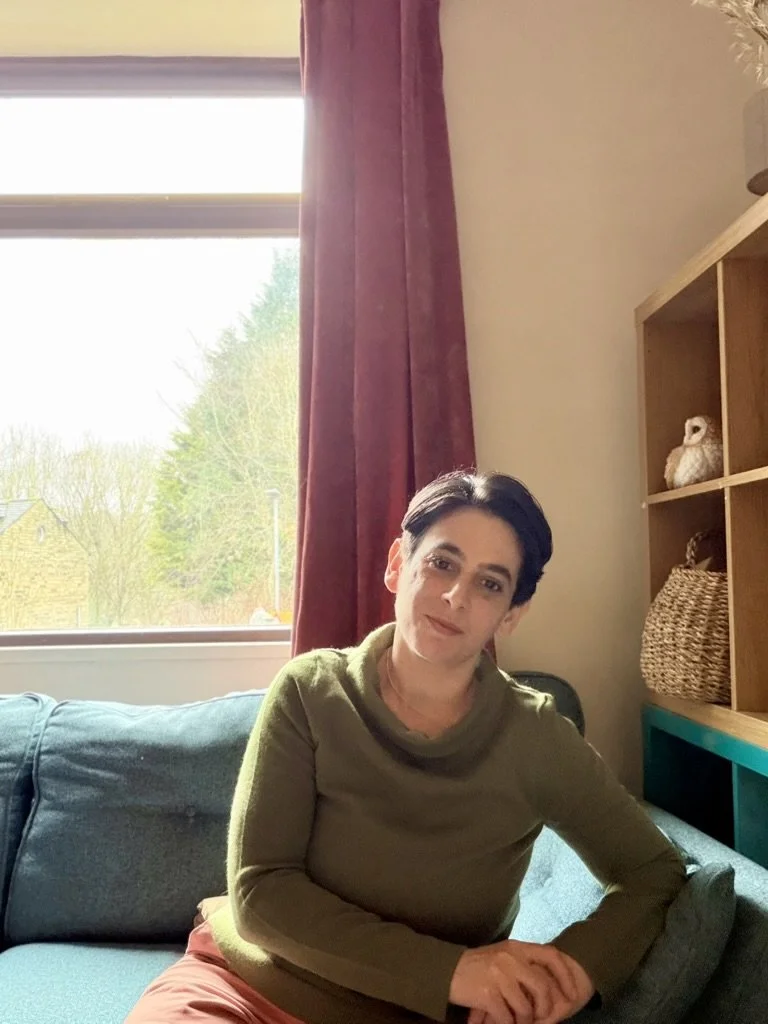
Michelle Goldsmith, MS, MBACP, MNCPS (Acc.) (she/her) is a psychotherapist and counsellor in private practice. She originally trained and practised as a dance/movement therapist and has been a practitioner of hatha yoga and mindfulness for more than twenty years.
She has worked in mental health for over twelve years across the US and the UK. In New York City she worked as a dance/movement therapist in adult inpatient psychiatry and in a specialist educational setting with neurodivergent children — much of it supporting people for whom being understood through words was extremely difficult or unavailable. She remains interested in the boundary between what is communicated in words and what is expressed through the body in sensation, gesture, movement and action.